

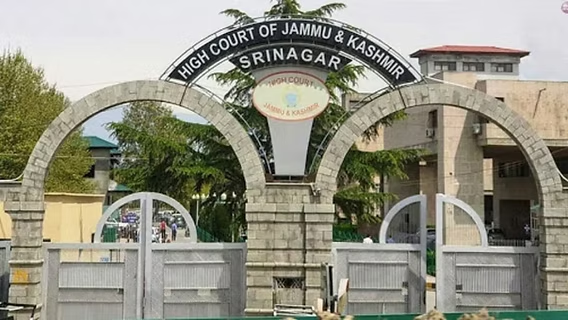
Pawan Kumar …..Appellant(s)/Petitioner(s)
Versus
Ranbir Singh .….Respondent(s)
Date of Order:-02.05.2025
The Cheque Bounce Dispute in Detail
The case began when Ranbir Singh approached the court after two cheques issued by Pawan Kumar were dishonoured. The first cheque, dated January 20, 2021, was for ₹10 lakhs but bounced due to “illegible signatures of the drawer.” The second cheque, dated January 26, 2021 for ₹11 lakhs, was returned with the remark “insufficient funds.” Together, these transactions formed the basis of the complaint under Section 138 of the Negotiable Instruments Act.
The Problem With the Legal Notice
On April 28, 2021, Ranbir’s lawyer sent a formal demand notice to Pawan Kumar. While the notice correctly described the two dishonoured cheques and their total value of ₹21 lakhs, it contained a crucial error. In the final paragraph where payment was demanded, the amount mentioned was only ₹50,000 instead of the full ₹21 lakhs. This discrepancy became the central issue in the legal battle that followed.
Pawan Kumar’s Legal Challenge
Pawan Kumar argued that this mistake made the entire notice invalid. His legal team pointed to Supreme Court judgments where similar errors had led to cases being dismissed. They maintained that the law requires strict compliance, and any deviation – even if unintentional – should nullify the complaint. The petitioner’s position was that since the notice demanded less than what was actually owed, it failed to meet legal requirements.
The Court’s Careful Examination
Justice Rajnesh Oswal, presiding over the case, took a nuanced approach. The judgment carefully analyzed the notice’s wording, noting that while the demand paragraph mentioned ₹50,000, the rest of the document clearly referred to the two cheques totaling ₹21 lakhs. The court observed that the notice specifically used the term “cheque amount,” which in context clearly meant the total value of the dishonoured instruments.
Legal Precedents Considered
The decision referenced several important cases that shaped its reasoning. In Suman Sethi v. Ajay Churiwal, the Supreme Court had ruled that notices should be read as a whole rather than focusing on isolated parts. Another key precedent, Central Bank of India v. Saxons Farms, established that the purpose of such notices is to give the cheque issuer an opportunity to rectify the situation. These rulings supported the view that minor errors shouldn’t defeat justice when the essential demand is clear.
Final Resolution
After thorough consideration, the High Court dismissed Pawan Kumar’s petition, allowing the original complaint to proceed. The ruling emphasized that justice should not be obstructed by technicalities when the core facts and intentions are evident. This balanced approach maintains the law’s integrity while preventing its misuse through overly strict interpretations of procedural requirements.
About the Author: Neeraj Gogia, Advocate, 9891800100, specializing in criminal law jurisprudence. This article is intended for informational purposes only and does not constitute legal advice.
© 2025 [Gogia crime briefs]. All rights reserved.
#lexeagle #neerajgogia #cheque #linkedin #summons #headnotes #gogiacrimebriefs #bounce #court #law #legal #case